Digital Agents Explained: What Are AI Agents and How Do They Work?
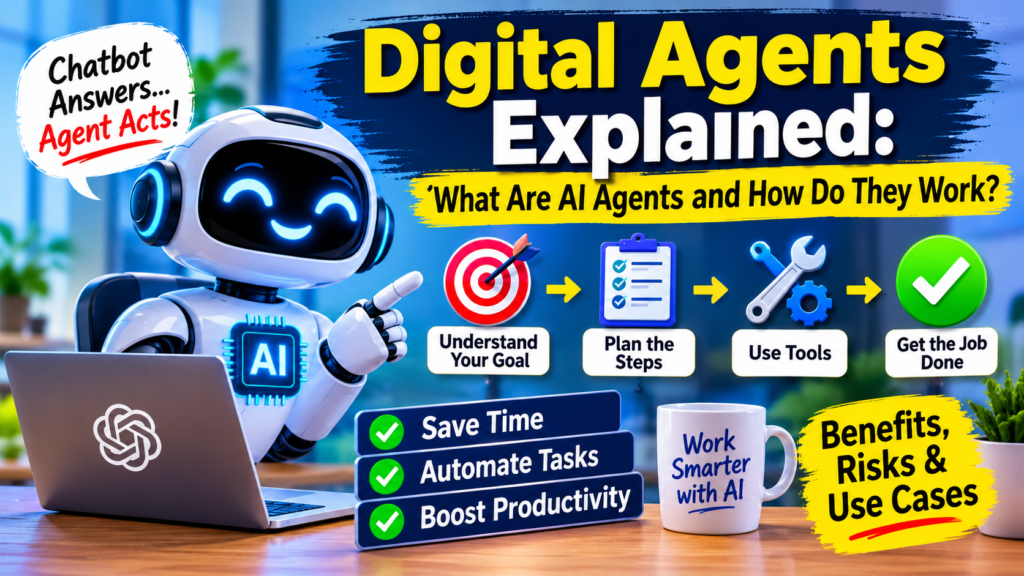
An AI agent is software that takes a goal, works out the steps, uses tools and gets the job done with very little help from you. A normal chatbot answers. An agent acts.
Think about the last time you used an AI chatbot. You typed a question, it replied, and then you did the real work yourself: copied the answer, opened another app, sent the email, booked the ticket. An AI agent is built to take over that second half.
In this guide I will explain what AI agents are, how they work under the hood, where you can already see them in daily life, and what to watch out for. No jargon without explanation, no hype.
What Are AI Agents? A Simple Definition
An AI agent is a program powered by an AI model (usually a large language model, the same kind of technology behind ChatGPT, Claude and Gemini) that can:
- Understand a goal you give it in normal language
- Plan the steps needed to reach that goal
- Use tools such as web search, email, a calendar, a spreadsheet or code
- Check its own results and try again if something went wrong
The key word is autonomy. You describe the destination, and the agent chooses the route.
The weekend trip planner
You say: “Find me the cheapest way to get from Lahore to Karachi next Friday, arriving before 6 PM, and add it to my calendar.”
A chatbot would give you general travel advice. An agent would:
- Search flight and train options for that date
- Filter out anything arriving after 6 PM
- Compare prices and pick the best match
- Ask you to confirm, then add the trip to your calendar
You gave one sentence. The agent did four jobs.
AI Agents vs Chatbots vs AI Assistants
These three words get mixed up all the time. Here is the difference in one glance:
| Chatbot | AI assistant | AI agent | |
|---|---|---|---|
| Main job | Answers questions | Helps you with tasks | Completes goals on its own |
| Who decides? | Pre-set rules or you | You, with suggestions | The agent, within limits you set |
| Steps | One reply at a time | A few steps with you | Many steps in a row |
| Uses tools? | Rarely | Sometimes | Almost always |
The line is blurry. Many popular AI apps now have an “agent mode”, so one product can behave like an assistant in one moment and an agent in the next.
How Do AI Agents Work? Step by Step
Under the hood, nearly every agent follows the same loop. It is easier to understand if you imagine a new employee on their first day.
Step 1: Understanding the goal
The agent reads your request and works out what “done” looks like. Clear requests get better results. “Find me a good laptop” is vague. “Find three laptops under 150,000 rupees for video editing” is something it can act on.
Step 2: Planning the steps
The AI model breaks the goal into smaller tasks and decides the order. This planning ability is what separates agents from simple automation.
Step 3: Using tools
The model on its own can only produce text. Tools give it hands: it can search the web, read a file, send a message or run code. Each tool is a small function the agent is allowed to call.
Step 4: Checking and fixing
After each action, the agent looks at what happened. If a website did not load or the numbers do not add up, it adjusts and tries another way. This loop of think, act, observe repeats until the goal is met or the agent asks you for help.
The Main Parts of an AI Agent
- The model: the “brain” that reads, reasons and writes.
- Memory: short-term memory keeps track of the current task; long-term memory can remember your preferences across days.
- Tools: the apps and functions it can use.
- Instructions and limits: rules about what it may and may not do, such as “never send an email without asking me.”
The freelancer’s client follow-up
Ayesha is a freelance graphic designer. Every Monday she used to spend an hour chasing clients about unpaid invoices and pending feedback. Now she sets up an agent with one instruction:
“Every Monday, check my invoice sheet, draft a polite reminder for anything unpaid for more than 7 days, and show me the drafts before sending.”
- The agent opens the invoice sheet
- It finds overdue invoices
- It writes a friendly, personal reminder for each client
- It waits for Ayesha to approve, then sends
Her hour became five minutes, and she stays in control because the agent asks before it sends.
Types of AI Agents
Researchers describe agents in several ways. These are the ones worth knowing:
- Simple reflex agents react to a situation with a fixed rule, like a thermostat turning on the heat.
- Goal-based agents choose actions that move them toward a target, like a navigation app finding a route.
- Learning agents improve over time from feedback.
- Multi-agent systems use several agents that each handle one part of a job, for example one researches, one writes, one reviews.
Where You Can See AI Agents Today
Agents are no longer only a research idea. You will find them in a few main areas:
- Coding agents that read a project, write code and fix bugs
- Research agents that search many sources and write a summary
- Browser agents that can click, scroll and fill in web forms for you
- Automation agents that connect apps like email, sheets and chat
- Customer support agents that resolve common questions for businesses
How Students and Freelancers Can Use AI Agents
You do not need to be a programmer. Here are practical starting points:
- Students: gather sources for an assignment, turn lecture notes into revision cards, build a study schedule.
- Freelancers: draft proposals, track deadlines, follow up with clients, research a client’s business before a call.
- Small business owners: answer repeat customer questions, summarise daily sales, schedule social posts.
Benefits of AI Agents
- They save time on repetitive work
- They can run tasks while you do something else
- They keep working on step four even when you are busy with step one
- They make advanced tools usable with plain language
Risks and Limits You Should Know About
Agents are powerful, which is exactly why they need care.
- Mistakes happen. Agents can misread a request or act on wrong information. Always review important actions.
- Privacy matters. Do not give an agent access to bank details, passwords or private files unless you fully trust the service.
- Too much freedom is risky. Start with “ask me before you act” settings.
- They are not human. Tasks that need empathy, ethics or tricky judgement still need a person.
Will AI Agents Take Your Job?
Honest answer: they will change many jobs more than they will erase them. Repetitive, rule-based tasks are the most exposed. Work that depends on creativity, trust, negotiation and real-world judgement is much harder to hand over. The people who learn to direct agents will have an advantage over those who ignore them.
How to Get Started With AI Agents
- Pick one small task that is repetitive and low risk.
- Write clear instructions including what “done” looks like.
- Choose a beginner-friendly tool with an agent or automation feature.
- Keep approval on until you trust the results.
- Improve and repeat. Refine your instructions after every run.
Frequently Asked Questions
What is an AI agent in simple words?
It is AI software that can plan and complete a task for you using tools, instead of only giving advice.
Is ChatGPT an AI agent?
A basic chat is closer to an assistant. When it browses, runs code or completes multi-step tasks on its own, it is acting as an agent.
What is the difference between an AI agent and a chatbot?
A chatbot mainly talks. An agent takes actions across several steps to reach a goal.
Are AI agents free to use?
Some have free plans with limits, others are paid. Check each tool’s official page for current pricing.
Are AI agents safe?
They can be, if you limit their access, avoid sharing sensitive data and review important actions before they happen.
Can I use AI agents without coding?
Yes. Many tools let you describe the task in plain language.
Final Thoughts
AI agents are not magic, and they are not science fiction. They are a practical next step: from AI that talks to AI that does. Start small, stay in control, and let the boring work move off your plate.

admin
Writer at Digital Fact World, sharing simple and fact-checked guides on the digital world.